
3.12 – Reflex incontinence
In this section, find out how neurological conditions affect bladder dysfunction whether there is partial damage to the nerve pathways or when the spinal cord is totally damaged and reflex incontinence will occur.
As we discussed previously normal bladder function is controlled by the central and peripheral nervous systems and normal micturition depends on the coordination of the brain, spinal cord, bladder and urethra.
To help us understand how different neurological conditions may affect bladder function it is helpful to consider what we understand by ‘reflex incontinence’.
Reflex incontinence will occur if the spinal cord is totally damaged and no nerve impulses or messages are received up or down the spinal cord.
If this happens the bladder would be controlled by the simple ‘reflex arc’. As we have seen previously when looking at how bladder control is developed, this is what we see with a baby’s bladder control.
The following diagram shows how this can happen.
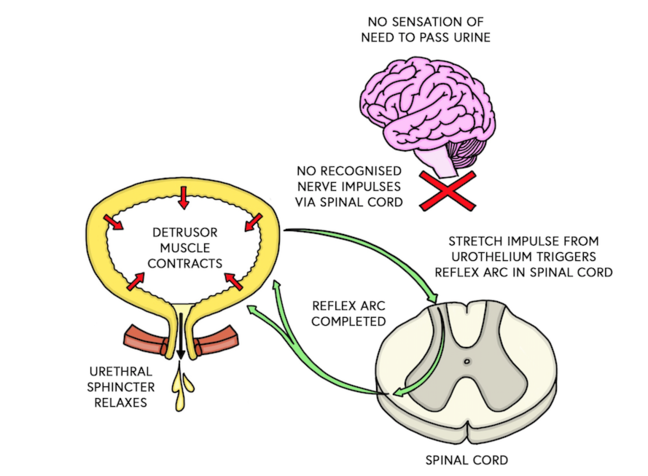
Figure 3.3: Reflex incontinence.